

I don’t think anyone enjoys the leg day at the gym. The leg day’s pain might, nevertheless, be enjoyable for certain people. Lunges are more of a lower body workout than specifically a leg exercise. Almost every muscle in the lower body may be shaped and strengthened with lunges, including the hips, glutes, quadriceps, hamstrings, and calves. Your lower body is strengthened, your core strength and muscle mass are increased, and it helps you achieve the buttocks you’ve always wanted.
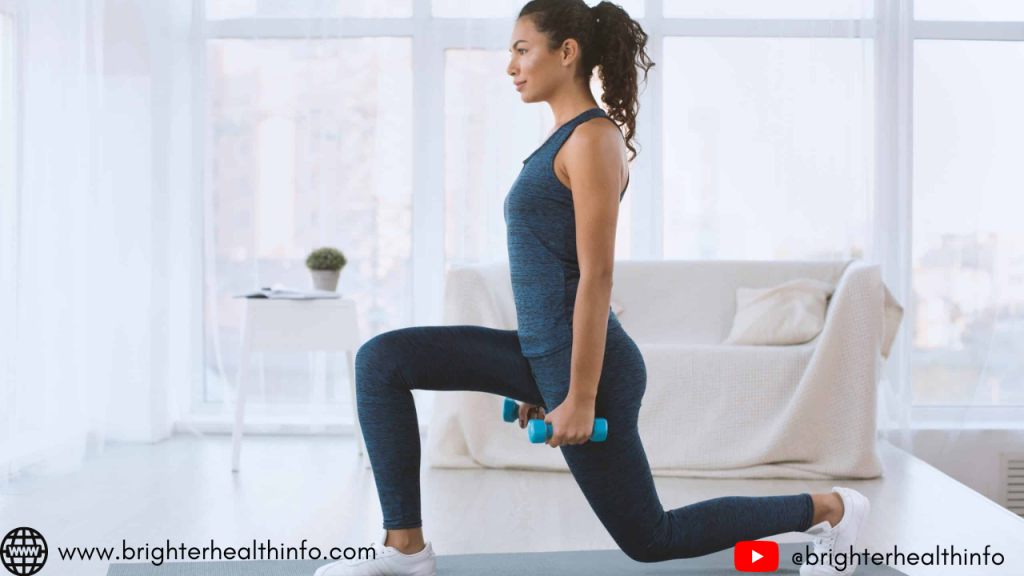
The most amazing aspect of thrusts is that it requires no gear, are extraordinarily protected, and are simple to learn. The lurch is likewise a one-sided workout, meaning you train each side of your body in turn. It makes the thrust the best for distinguishing and rectifying any muscle irregular characteristics you have between your left and right side.
5 Types of lunges
1: Stationary lunges
The thighs, glutes, and hamstrings are the lower body muscles targeted by this sort of lunge. The hamstrings, quadriceps, and glutes are eccentrically contracted as it descends.
In stationary lunges, you can balance, stabilize, and support your complete body by placing your weight on your front leg and using your back leg for support.
2: Side lunges
Side lunges work the quadriceps, hips, legs, and inner and outer thighs. You benefit from its strength, balance, and stability. A nice change from your body’s usual movements is what side lunges teach you to do with your body.
3: Walking lunges
The walking variation strengthens your glutes, hips, and core while enhancing overall stability. The downward motion is constant in this form, and all the leg and thigh muscles receive the same amount of pressure. Adding weights will make walking lunges more challenging. While performing this exercise, you can grip a dumbbell in either hand.
4: Reverse lunges
Your core, glutes, and hamstrings are worked out during reverse lunges. It is perfect for persons with knee issues, balance issues, or limited hip movement.
5: Twist lunges
Your ankle and foot muscles are worked during twist lunges. To more fully engage your core and glutes, add a twist to stationary, walking, or reverse lunges.
Advantages of Lunges
1: Enhance body coordination and balance
Our body’s balance and coordination are greatly enhanced by luges. As you exercise your lower body unilaterally, you work on each side of your body separately. The single-leg performance necessary for lunges increases the neurological and muscular demands by requiring joint stability and control. Your abdominal muscles and core are worked throughout this exercise. Your posture and balance will both improve as a result of having a strong core.
2: Losing weight
One of the best workouts for losing weight is the lunge. Lunges, which promote the growth of lean muscle and the reduction of body fat, target the main muscle groups in your lower body. Also, it raises your resting metabolism, which boosts your capacity to burn calories and lose extra weight.
3: Increase flexibility.
Flexor muscles from the lower portion of our body are overlooked while doing exercise. Strolling lurches support the adaptability of the hip flexor muscles, which will generally turn out to be tight because of the inactive way of life we lead. Strolling rushes increment the adaptability of the hip flexor muscles, which will generally turn out to be tight because of the inactive way of life we lead.
4: Activation of the Gluteal Muscles
One muscle region that is frequently neglected during routine workouts is the gluteus muscle. The glutes can be worked to increase speed, lower back pain, and power production. With consistent exercise, walking lunges might assist in concentrating on their activation and mobilizing them.
5: Establish muscle symmetry
One of the main advantages of lunges is the correction of muscular asymmetries. Due to the number of bilateral, there is a danger that muscular asymmetries will go undiagnosed or untreated. Lunges and other unilateral workouts can thereby promote muscle strength and hypertrophy in a weaker limb, reducing movement and developmental asymmetries as well as compensatory patterning.
6 : Improved spinal health
Lunges give the spine strength and stability. Lunges relieve pressure from your spine to help it become flexible and pain-free as you work on other portions of your body.
7: Reduces injury risk
Although lunges don’t stop injuries, they do develop the muscles (both large and small) that help you maintain stability while carrying a high burden.
MUSCLES AFFECTED BY LUNGES
Lunges’ ability to increase muscular mass, improve body strength, and tone your body is its most crucial benefit. Lunges primarily work the legs, buttocks, and core muscles. A person who performs lunges as part of their exercise program will undoubtedly have better posture and range of motion. Abs, back, gluteal, quadriceps, hamstrings, and calves are just a few of the muscles that lunges may efficiently target.
HOW TO GET EFFECTIVE RESULTS?
You may incorporate lunges into your regular regimen because they are simple, accessible exercise moves. The outcomes you achieve after performing lunges are unrivaled. It won’t happen overnight, though, unless a miracle happens. To continue seeing improvements in yourself, you must continue being consistent and staying on a regular schedule.
You will undoubtedly see changes in your body’s sculpting and muscular mass if you incorporate a few sets of lunges into your regular exercise routine. After a few weeks, if completing basic lunges becomes easier for you, add a challenge and up the intensity by performing more challenging types of lunges, such as adding weights or doing more lunges each set.
Precautions
1. Pay close attention to your breathing and do walking lunges with a qualified instructor because falling is a possibility.
2. While performing this exercise, engage your core and maintain balance in your torso and hip.
3. When practicing walking lunges, keep your upper body and spine straight.
Disclaimer:
The information provided at this site is only meant for educational purposes and is not meant to replace medical care from a qualified health care provider. The reader should speak with their doctor to assess whether the information is suitable for their condition due to individual needs that are specific to them.


